
Salsa Gadgets
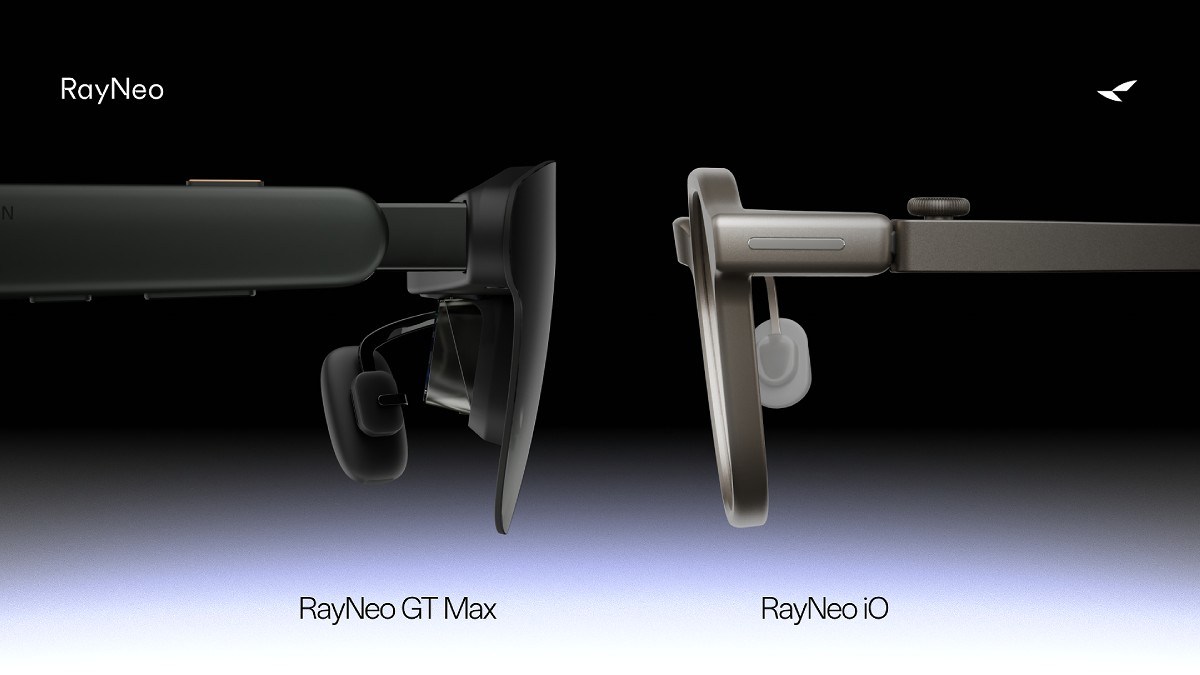
RayNeo has introduced two new smart glasses families aimed at very different use cases. The iO series focuses on productivity and ambient AI, while the GT lineup is designed for immersive gaming and movie watching.

The RayNeo iO Smart Glasses are designed for comfortable all day use, weighing 33g with a balanced 50:50 weight distribution. The frames use AZ91D magnesium aluminum alloy, while the temples are made from aerospace grade titanium.
The iO glasses feature a monochrome green waveguide display powered by the Firefly Nano Engine. Their Blue Lake waveguide offers 97% transparency, allowing information to remain visible only to the wearer.
The display reaches up to 1,300 nits and can function as a teleprompter or provide live translation across 55 languages and 109 accents with around one second of latency.

A four microphone array allows the glasses to capture voice commands, while a bone conduction sensor helps isolate the wearer’s voice in noisy surroundings. RayNeo’s Ambient AI Life Log can also track schedules and conversation context and remind users to add events to their calendar.
The iO glasses come with RayNeo AI and Gemini 3.1 Flash Lite, while the companion app lets users switch between Gemini, ChatGPT, Claude and DeepSeek. A 240mAh battery provides up to two days of regular use, including up to 18 hours of audio recording or 6.2 hours of continuous translation.
The glasses have an IP54 rating and include a hardwired LED that alerts people when recording or translation is active. They also support basic motion gestures and feature a Smart Crown rotary dial. There are no speakers, as the interface is entirely text based.
RayNeo’s GT lineup consists of the GT and GT Max, both featuring full color microOLED displays and four speakers tuned with Bang & Olufsen. The standard GT produces a virtual 231 inch display with a 46 degree field of view, while the iO has a much narrower 23.5 degree field of view.
The GT Max offers three virtual screen sizes of 227, 267 and 307 inches, with the largest option providing a 59 degree field of view. The GT weighs 68g, while the GT Max weighs 78g.
Both models include dedicated 3DoF tracking hardware with Follow, Pinned and Steady modes. These allow the virtual screen to follow the user’s view, remain fixed in virtual space or stabilize movement while walking or traveling.

The GT Max is also the first AR glasses to support Dolby Vision content through RayNeo’s new Pocket TV Pro. An AI powered SDR to HDR feature is available for standard dynamic range video.
The Pocket TV Pro is essentially a compact Android powered media device designed to provide a dedicated source for the glasses. It uses the Amlogic S905X5M J chipset with 3GB of RAM and 64GB of storage, along with a microSD slot supporting cards up to 1TB.
A 6,500mAh battery can power both the Pocket TV Pro and connected glasses for up to 5.5 hours of streaming. The device also handles the SDR to HDR conversion.

The RayNeo iO, GT and GT Max glasses will go on sale from September 4, with pricing yet to be announced. The iO will be available in Polar Night and Dune, while both GT models support official prescription lens inserts. The GT Max will also be offered in three IPD sizes.
The new glasses will be sold through RayNeo’s website and Amazon, and will be demonstrated at IFA from September 4 to 8.
