
Salsa Gadgets
SK hynix has officially announced that it has started delivering samples of its next-generation HBM4E memory to selected customers, marking a significant step forward in high-bandwidth memory development for AI and data center applications.
HBM, or High Bandwidth Memory, is widely used in AI accelerators due to its extremely high data throughput compared to traditional DDR memory. The new HBM4E standard from SK hynix delivers a major performance upgrade over its predecessor, HBM4.

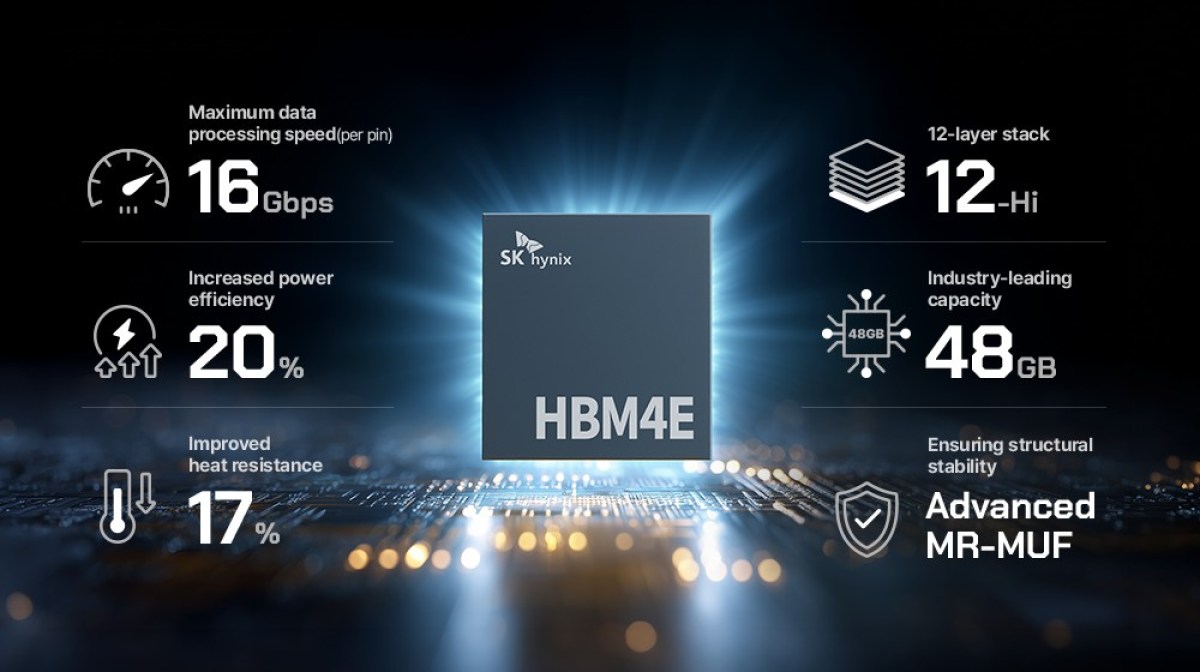
According to the company, HBM4E achieves a data transfer rate of 16Gbps per pin, compared to 10Gbps per pin on the previous HBM4 generation. This represents a substantial increase in bandwidth, making it better suited for demanding workloads such as large-scale AI model training and inference.
For comparison, Samsung’s earlier HBM4E samples reportedly reached 14Gbps per pin, placing SK hynix ahead in this early sampling phase.
The current SK hynix design uses a 12-layer stack configuration, with each stack delivering up to 48GB of memory capacity. In real-world applications, multiple stacks are typically combined in AI accelerators to achieve much higher total memory bandwidth and capacity.
Beyond raw performance improvements, SK hynix also highlights significant gains in efficiency and thermal management. The company claims HBM4E is approximately 20% more power efficient than the previous generation, which is increasingly important as AI workloads continue to scale.

The memory is manufactured using MR-MUF (Mass Reflow Molded Underfill) technology, which introduces a protective liquid layer between silicon dies. This improves structural stability and heat management by reducing thermal resistance by approximately 17%, helping systems maintain performance under heavy load.
SK hynix stated that the successful sampling of 12-layer HBM4E modules reflects its continued leadership in advanced memory development and its close collaboration with industry partners. The company added that it plans to move toward mass production in line with partner readiness and demand.
With AI hardware rapidly evolving, HBM4E is expected to play a key role in powering next-generation accelerators, particularly in large-scale cloud and enterprise AI systems where memory bandwidth is a critical bottleneck.
