
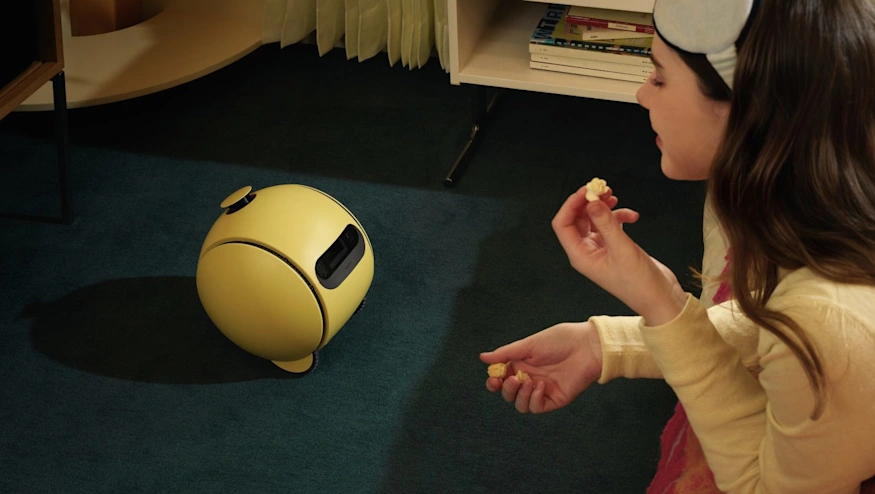


The announcement of Google Gemini integration with Samsung’s Ballie instantly captured attention — the idea of a mobile AI companion rolling around your home, answering questions conversationally, reading context from its environment, and even projecting content onto walls sounds futuristic and genuinely impressive. On paper, it represents the next step toward personal home robotics, where assistants are not just speakers or screens, but mobile entities capable of perceiving the world more like we do.
Gemini is the most compelling part of this vision. As a multimodal AI model, it understands speech, text, images and complex queries, which means Ballie could hold natural conversations, provide information, manage schedules, suggest actions based on user habits and even display content visually through its projector. Imagine asking Ballie to show recipes on the kitchen wall, play a film on the ceiling before bed or roll over to the living room to brief you on your day — all of that becomes technically possible with Gemini as its core.
Yet, this is where enthusiasm meets a practical limit. Intelligence alone doesn’t make a robot useful in the real-world sense. Ballie can interpret instructions, but with no arms, grippers or manipulation hardware, it cannot complete most household tasks that define a true assistant. It cannot cook, clean, tidy items, retrieve objects or carry out physical chores. Ballie becomes less of a helper and more of a rolling smart display — impressive, interactive, conversational, but fundamentally constrained.
This disconnect — a powerful AI brain inside a limited physical shell — highlights a broader challenge in consumer robotics. Many breakthroughs in AI lead us to believe real domestic robots are imminent, but mobility and intelligence are only half the equation. Without the ability to manipulate the environment, the robot becomes a companion or entertainment tool rather than something that lightens daily workload.
Of course, that doesn’t make Ballie irrelevant. It creates a new kind of smart-home experience: more dynamic than a stationary smart speaker and more friendly than a tablet. For users who want ambience, presence and a touch of futuristic charm, Ballie could be delightful. Still, expectations should be realistic. The addition of Google Gemini makes Ballie smarter, more conversational, more aware — but not necessarily more useful in the physical, practical sense most people imagine when they hear the words home robot.
The excitement around Gemini plus Ballie is justified, but the takeaway is clear. True home assistance requires more than intelligence — it requires capability. Until robots can interact physically with the world, AI companions like Ballie will remain exciting to watch, entertaining to interact with, and innovative in concept, but ultimately limited in what they can accomplish for everyday life.
